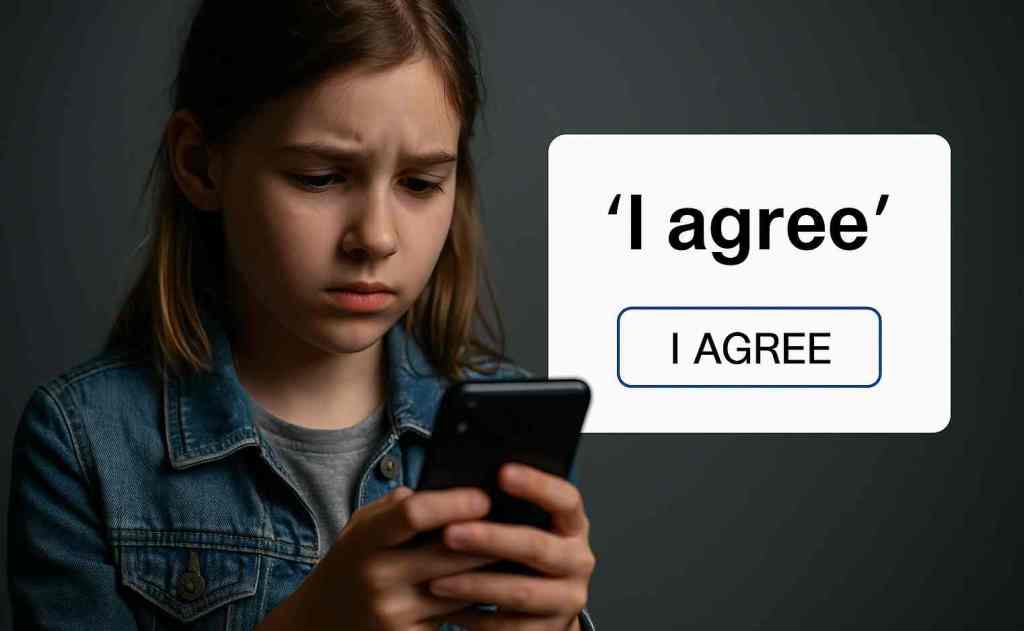
‘I Agree’: The Price of Your Child’s Click

Would you let your child sign a contract with a corporation that profits from her/his image, tracks their location, collects their data, and limits your ability to sue in court?

No? Then, you must understand what happens when your child begins to scrolls.

One click = a legally binding contract.

That’s all it takes to hand over their digital rights and, sadly, yours.

My daughter is almost twelve, and she’s been begging for a phone. “Everyone has it,” she says.
But I grew up without one, so one question keeps bugging me: Is my child old enough for what’s coming through that screen? Because, let’s be honest, a phone today isn’t just a device to make a call. It’s an admission ticket to a digital universe! It’s a portal into an adult internet, strangers, cryptic algorithms, and hidden contracts.

What scares me the most is access to the unknown. Even if I forbid certain applications, she will eventually install social media because all kids do! And although platforms like Instagram, TikTok, and Snapchat require users to be at least 13, it’s incredibly easy for children to bypass this rule.
Kids lie about their birthdate. No parental verification nor ID checks exist, so one click—”I agree”—gets them in.

But wait, does anyone ever read what they agree to? Most adults never do, so we can’t expect kids to read the terms.

Yet, this one blind click binds them into a legal contract with the platform, permitting the app to access their phone and track their location. Moreover, it limits the ability to sue the company in court, often forcing you into private arbitration, even for potential privacy violations.

Moreover, this “I agree” click opens the door to instant feeds—the content parents may disapprove of: perverse images, violent or sexually provocative clips, and strangers that may influence your child more than we wish for. Sadly, neither you nor your child have much control over the screen. The platform’s algorithm decides what shows up.

Once the account is live, multiple predators have a direct line to your child through comments, likes, or an instant DM. You might think their profile is private, but most platforms still allow message requests from strangers—and your child might not even know what’s safe to open.

The Children’s Online Privacy Protection Act (COPPA) is a federal law that’s supposed to protect kids under 13 from online data collection. Other laws, like consumer protection rules, unfair practice regulations, and even state-level privacy acts, also apply to kids and social media platforms. Still, most platforms aren’t verifying anything, and much of the responsibility lands in parents’ hands.

So, how old should your child be to get a cell phone?

I don’t have all the answers.
But if they have one, check it regularly. See what apps they’ve installed. Look at who they follow and what’s showing up in their feed. Talk to them, even if they roll their eyes.

Finally, before we hand over the phone, we need to understand the rules and consequences that come with it. Read the terms. Because once they say “I agree,”—it’s a contract.

© 2025 WolverineLily🌹


Note: This post is for informational purposes only and isn’t legal advice.
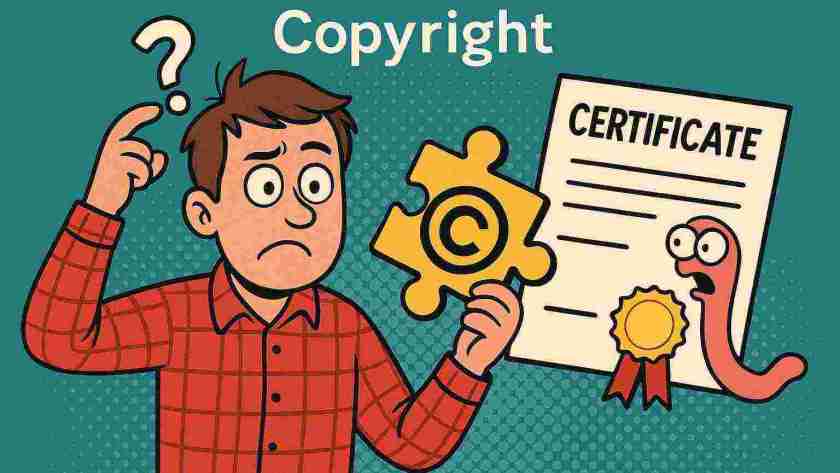
Think Your Work Is Protected? What You’re Missing About Copyright ©?

Today was a big day. I received the official certificate of registration for a book I wrote and plan to publish. It’s now protected under U.S. copyright law.
I’ve often marked my posts with © 2025 WolverineLily 🌺, but I started wondering… do people actually know what that means, or any text surrounding the © symbol? And does official registration change anything?

The answer is yes, and it matters more than most realize.
Let’s break down copyright basics, the meaning behind my little signature mark, why the Copyright Notice is important to creators.

What is Copyright?
Copyright is a legal right that gives the author control over how others use their work. It belongs to the person who created something (a photograph, story, or poem), and protects that work from being copied, shared, or used without the creator’s permission. There are a few limited exceptions (e.g., fair use), but in general, if someone wants to use your work, they need your permission.

Here, I’m keeping things simple and focusing on literary works (poems, stories, and blog posts). But copyright goes beyond. It applies to any original work that’s fixed in a tangible form, meaning it’s written down, recorded, saved, or otherwise captured in a physical or digital format.

However, writers must understand: ideas alone are not protected under copyright law. Only the original expression of those ideas are covered. So, if you write a story about vampires, pink dragons, witches, or talking cars, it’s the story itself (the structure, language, scenes, and dialogue) that’s protected. Not the general idea of your characters.

Copyright protection depends on how you develop and express those ideas, not the themes or concepts themselves. Think of it this way: there are countless books about dragons, right? Still, you can still write your own without infringing. Even if you invent a totally unique dragon, only your specific expression of that dragon in your story is protected. The idea of a pink dragon with yellow horns that sings opera is not protected — only the way you write it.

When does this right begin?
The moment you create something and save it in a physical or digital way. Whether you write it down on paper, save it on your computer, or record it — you automatically own the copyright. You don’t need to file anything or fill out forms. For example, when you write a blog post or poem— the right is yours the second you hit save. Copyright protects your ownership from that moment.

But what about this © symbol?
The © symbol stands for copyright. You’ve probably seen it on books, songs, and websites. But here’s the key: the symbol itself doesn’t create the right. It simply indicates that the work is protected by copyright.
It’s a way for an author to say:
“This work is mine. I created it, it’s original, and I hold all the rights. You can’t copy or use it without my permission.”

If you’re a writer or blogger, using the © symbol is optional — but smart! You don’t need to use it for your work to be protected. Copyright exists automatically once you’ve created the work and saved it in a tangible form. However, adding the symbol to your posts or stories sends a clear message that you are the creator, and others cannot use your work without your consent.
And no — you don’t have to file anything to include a © symbol under your work.

What’s all that other stuff next to the © symbol?

The © symbol can stand alone or appear with a name, a year, or additional notes. This combination is called a copyright notice.
Let’s unpack different types of copyright annotations and what they mean. Starting with mine.😊

© 2025 WolverineLily 🌺
I use this under my poems and stories. I include it for two reasons:
One, I like to think of it as my signature — a personal mark that goes below my work.
Two, it puts readers on notice that I am the creator, the work is mine, and it can’t be used without my permission.
It’s like leaving my fingerprint — a clear way of claiming ownership.
Instead of “WolverineLily,” I could use my legal name (or a pen name), but I prefer not to. I chose to keep things casual and on-brand 🌺.

There are also different versions of copyright notices you might see. Let’s look at a few examples and what each one means:

© 2025 WolverineLily
This is a basic copyright notice (a little more formal without the flower). It includes the symbol, the year of creation or publication, and the name of the creator or copyright holder. You do not have to use your legal name in the copyright notice—a pen name, brand name or a corporate name are fine.

© 2025 WolverineLily. All rights reserved.
Here, “All rights reserved” adds a layer of legal warning. It emphasizes that no one can copy, use, or distribute your work without permission.
It’s very similar to the previous notice, but with a stronger, more traditional message, reinforcing that the copyright owner retains full control over how the work is used.

© 2025 WolverineLily. All rights reserved. Copyright Registered.
This version lets people know that the work has been officially registered with the U.S. Copyright Office. Sometimes, this kind of notice may also include the registration number.
Registration offers significant legal benefits, including: proof of ownership, eligibility for statutory damages, and the ability to sue in federal court.

Here’s the key: you can’t file a copyright infringement lawsuit unless your work is registered.

If my work is already protected, why register it?
It’s true, copyright exists the moment your work is created and saved. But registering it gives you real legal power. You can’t sue for copyright infringement unless your work is registered (this is a big one). Early registration lets you claim statutory damages and attorney’s fees, and it creates a public record that helps protect your rights.

In short: registration isn’t required, but if you want full protection, it’s a smart move.

If you’ve written something amazing, it’s worth protecting — Register it! It gives you the strongest legal shield. But, of course, you won’t register every single post. So drop that © symbol. It’s a tiny but mighty statement: “This is mine.”


This isn’t legal advice — just basic info to help writers understand their rights as creators.


Law School Blues: Hustles, Hurdles… or Hilarity

Dedicated to Law Students and Bar Exam Takers. You got this!! Good luck!


Law school felt like battling a monstrous beast,
From day one: a torturous intellectual feast.
Cases and books—an oppressive digest,
The LSAT was just the appetizer for this relentless quest!

Many groaned, calling the LSAT a dread,
Unaware it was a preview of sleepless nights ahead.
Reading, briefing, monotonous lore,
Parties a myth! All fun’s out the door!

Free time vanished, hobbies took flight,
Gym and karate? All gone overnight!
Constantly seated, my chair-bound plight,
Gained weight! Out of shape! Now, isn’t that right?

No midterms to ease, just finals—so grand;
One exam to decide if you sink or stand!
Finishing 1L, stress rockets in flight,
A 3-hour horse race final in the dead of night.

Graded on a curve, it’s anyone’s game,
Score high, yet still, can endure the shame.
Classmates as rivals, friends now in jest,
Cutthroat and brutal; law school’s no rest.

Three years of torture, sleepless and grim,
Reading and writing till your eyesight dims.
Friends? What friends? They all disappeared!!
Only on Christmas, some family cheered.

Then there’s the BAR, oh man, what a “treat,”
Study till you fall off your seat!
California’s the worst—tough as can be.
Fail—and an attorney you may never be!

Money? You ask, was it worth all the pain?
Well, lawyers ain’t rolling in endless champagne!
Huge responsibility and liability too,
Makes you ponder: Was this the right thing to do?

But if law is your passion; your heart’s true delight,
Maybe—just maybe—it’s worth the long fight.
Yet, if you dream of something else instead,
Run far from law school, run fast, my friend!