I almost signed an agreement I would never have advised my client to sign.
Why? Because even though I’m an attorney, I’m also a writer.
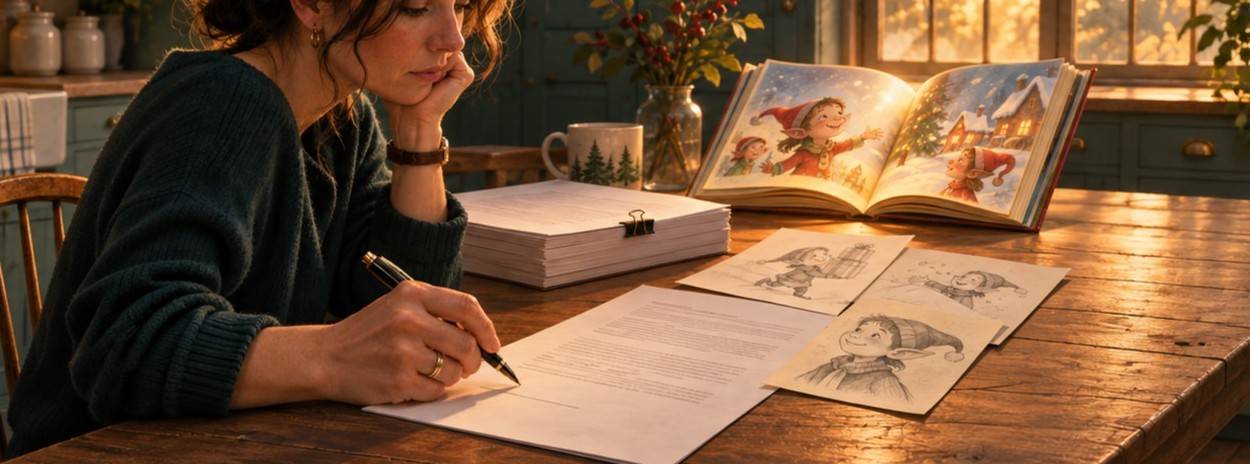
After years of writing and refining the story, I wanted to see it published. When I was finally done and ready for illustrations, I faced a new challenge: finding that “right” artist, whose vision would align with mine. I needed someone who would bring the elves to life the way they lived in my imagination.
I searched for a long time until I found an artist in Europe. But after five months (and only three sketches) it was obvious that she was too busy with her regular job and wasn’t going to complete my project.
Months later, I found someone in Indonesia. By then, I was pretty desperate, so I sent him the manuscript even though he refused to sign a nondisclosure agreement. He agreed to illustrate my book; however, he was not “comfortable” signing the contract I sent him. It was a short work-for-hire agreement stating that I would own the copyright to the illustrations he created for my book.
I revised the document, and yet he wasn’t “comfortable” with something else. I changed that to accommodate his ‘comfort.’ Then he didn’t like some wording. I kept revising it over and over. Yet, he refused to sign it.
Finally, depleted and frustrated, I sat down in my kitchen and read the whole document again. At that point, I didn’t feel comfortable signing it myself, and frankly, I wasn’t even sure I would own any rights to the illustrations!
Then I asked myself: If I were an attorney representing the writer, would I advise my client to sign this agreement?
I started laughing to myself.
“Of course, NOT!”
In that moment, I realized that even an attorney needs an attorney sometimes.
Authors need legal eyes to review the agreements. As creators, we don’t read for legal issues. The desire to publish is so blinding that we’re willing to sign away rights to the work we’ve spent years creating.
So before you sign anything, have an attorney read it. Spend the money and protect your work.
The answer is yes, and it matters more than most realize. Let’s break down copyright basics, the meaning behind my little signature mark, why the Copyright Notice is important to creators.
What is Copyright? Copyright is a legal right that gives the author control over how others use their work. It belongs to the person who created something (a photograph, story, or poem), and protects that work from being copied, shared, or used without the creator’s permission. There are a few limited exceptions (e.g., fair use), but in general, if someone wants to use your work, they need your permission.
Here, I’m keeping things simple and focusing on literary works (poems, stories, and blog posts). But copyright goes beyond. It applies to any original work that’s fixed in a tangible form, meaning it’s written down, recorded, saved, or otherwise captured in a physical or digital format.
However, writers must understand: ideas alone are not protected under copyright law. Only the original expression of those ideas are covered. So, if you write a story about vampires, pink dragons, witches, or talking cars, it’s the story itself (the structure, language, scenes, and dialogue) that’s protected. Not the general idea of your characters.
Copyright protection depends on how you develop and express those ideas, not the themes or concepts themselves. Think of it this way: there are countless books about dragons, right? Still, you can still write your own without infringing. Even if you invent a totally unique dragon, only your specific expression of that dragon in your story is protected. The idea of a pink dragon with yellow horns that sings opera is not protected — only the way you write it.
When does this right begin? The moment you create something and save it in a physical or digital way. Whether you write it down on paper, save it on your computer, or record it — you automatically own the copyright. You don’t need to file anything or fill out forms. For example, when you write a blog post or poem— the right is yours the second you hit save. Copyright protects your ownership from that moment.
Here’s the key: you can’t file a copyright infringement lawsuit unless your work is registered.
If my work is already protected, why register it? It’s true, copyright exists the moment your work is created and saved. But registering it gives you real legal power. You can’t sue for copyright infringement unless your work is registered (this is a big one). Early registration lets you claim statutory damages and attorney’s fees, and it creates a public record that helps protect your rights.
In short: registration isn’t required, but if you want full protection, it’s a smart move.