
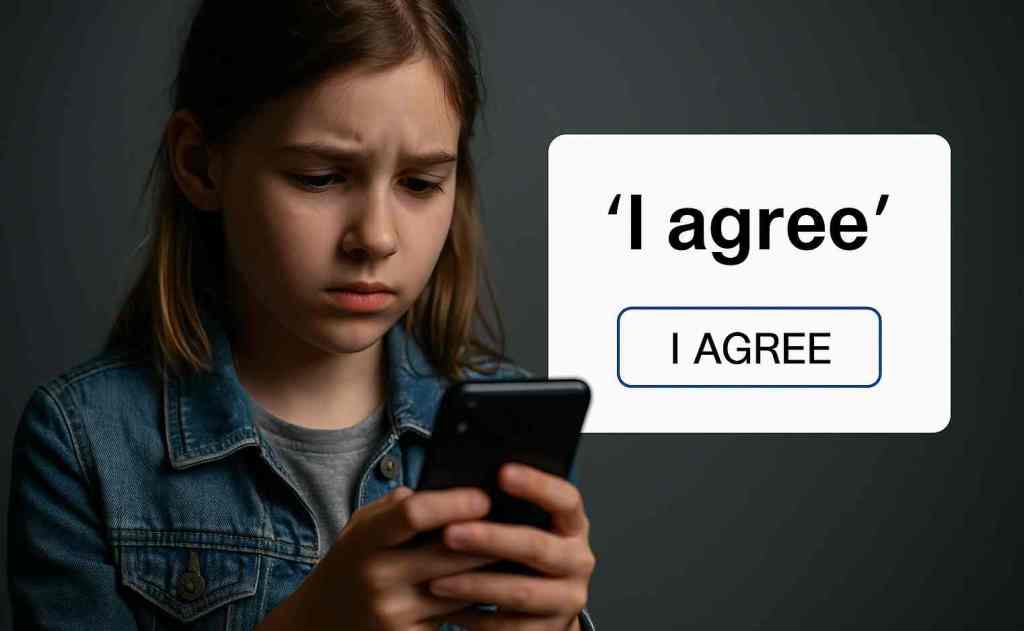
Would you let your child sign a contract with a corporation that profits from her/his image, tracks their location, collects their data, and limits your ability to sue in court?
No? Then, you must understand what happens when your child begins to scrolls.
One click = a legally binding contract.
That’s all it takes to hand over their digital rights and, sadly, yours.
My daughter is almost twelve, and she’s been begging for a phone. “Everyone has it,” she says.
But I grew up without one, so one question keeps bugging me: Is my child old enough for what’s coming through that screen? Because, let’s be honest, a phone today isn’t just a device to make a call. It’s an admission ticket to a digital universe! It’s a portal into an adult internet, strangers, cryptic algorithms, and hidden contracts.
What scares me the most is access to the unknown. Even if I forbid certain applications, she will eventually install social media because all kids do! And although platforms like Instagram, TikTok, and Snapchat require users to be at least 13, it’s incredibly easy for children to bypass this rule.
Kids lie about their birthdate. No parental verification nor ID checks exist, so one click—”I agree”—gets them in.
But wait, does anyone ever read what they agree to? Most adults never do, so we can’t expect kids to read the terms.
Yet, this one blind click binds them into a legal contract with the platform, permitting the app to access their phone and track their location. Moreover, it limits the ability to sue the company in court, often forcing you into private arbitration, even for potential privacy violations.
Moreover, this “I agree” click opens the door to instant feeds—the content parents may disapprove of: perverse images, violent or sexually provocative clips, and strangers that may influence your child more than we wish for. Sadly, neither you nor your child have much control over the screen. The platform’s algorithm decides what shows up.
Once the account is live, multiple predators have a direct line to your child through comments, likes, or an instant DM. You might think their profile is private, but most platforms still allow message requests from strangers—and your child might not even know what’s safe to open.
The Children’s Online Privacy Protection Act (COPPA) is a federal law that’s supposed to protect kids under 13 from online data collection. Other laws, like consumer protection rules, unfair practice regulations, and even state-level privacy acts, also apply to kids and social media platforms. Still, most platforms aren’t verifying anything, and much of the responsibility lands in parents’ hands.
So, how old should your child be to get a cell phone?
I don’t have all the answers.
But if they have one, check it regularly. See what apps they’ve installed. Look at who they follow and what’s showing up in their feed. Talk to them, even if they roll their eyes.
Finally, before we hand over the phone, we need to understand the rules and consequences that come with it. Read the terms. Because once they say “I agree,”—it’s a contract.
© 2025 WolverineLily🌹
Note: This post is for informational purposes only and isn’t legal advice.

 Wolverine Lily